Details
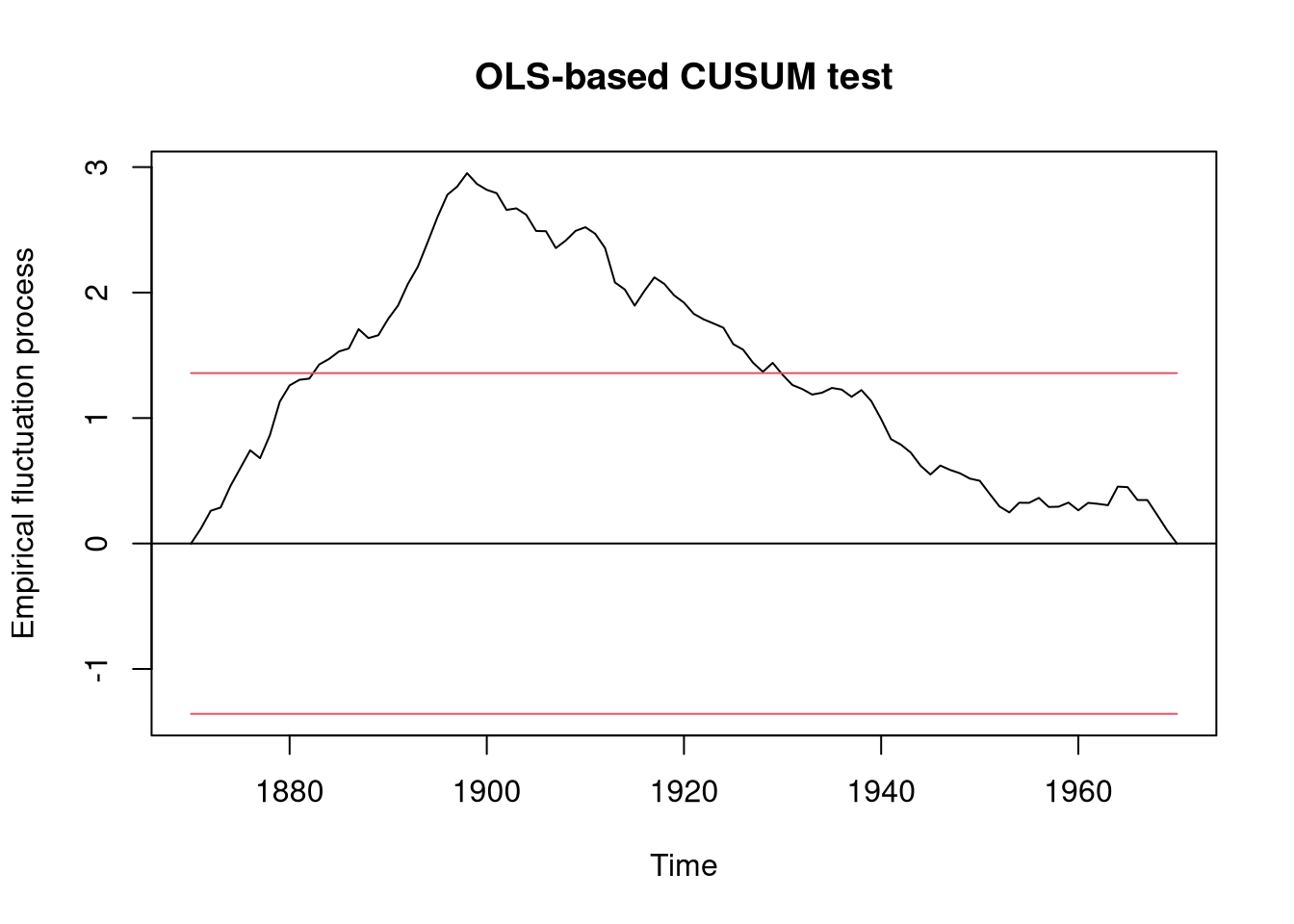
If type is one of “Rec-CUSUM”, “OLS-CUSUM”, “Rec-MOSUM” or “OLS-MOSUM” the function efp will return a one-dimensional empirical process of sums of residuals. Either it will be based on recursive residuals or on OLS residuals and the process will contain CUmulative SUMs or MOving SUMs of residuals in a certain data window. For the MOSUM and ME processes all estimations are done for the observations in a moving data window, whose size is determined by h and which is shifted over the whole sample.
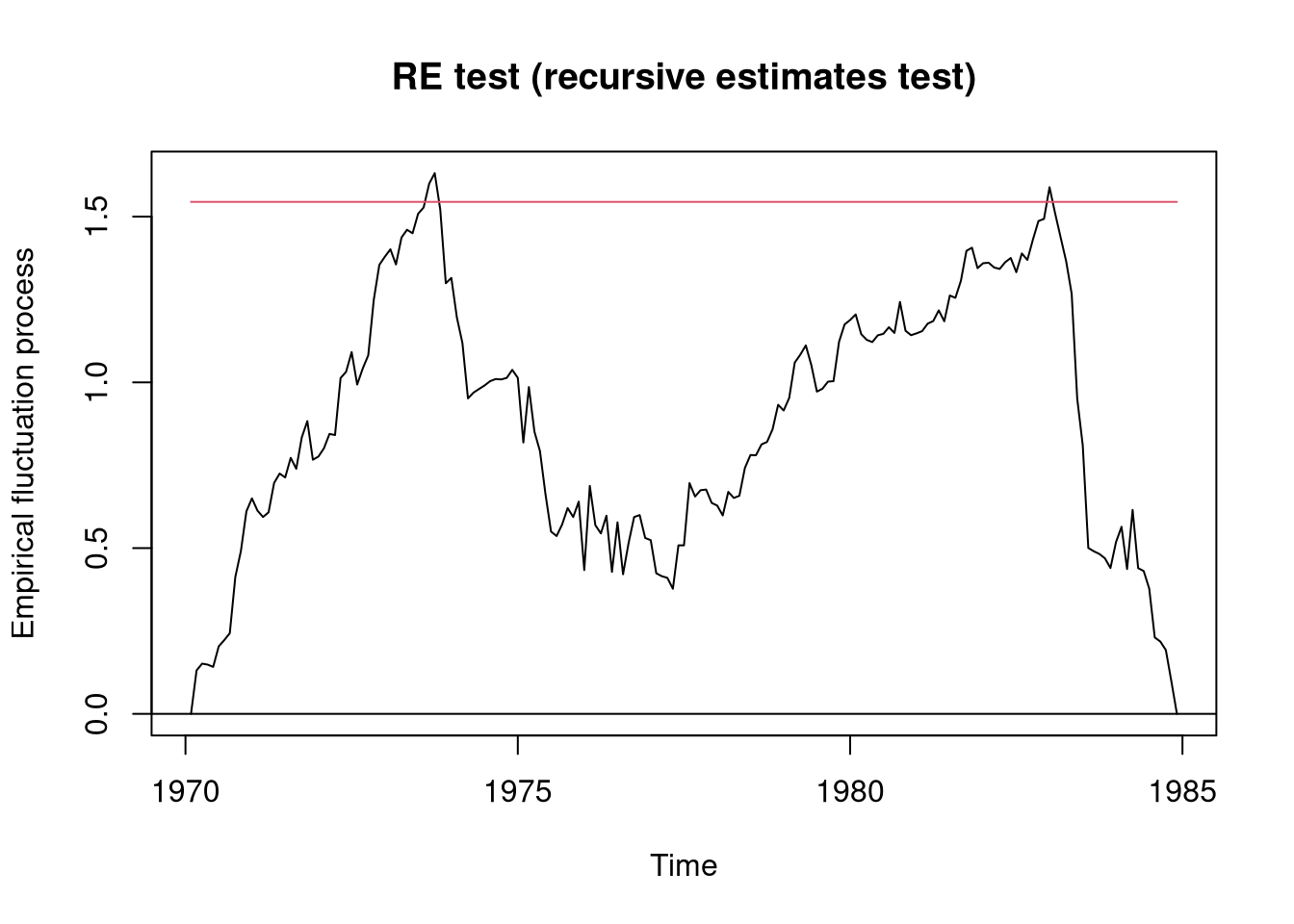
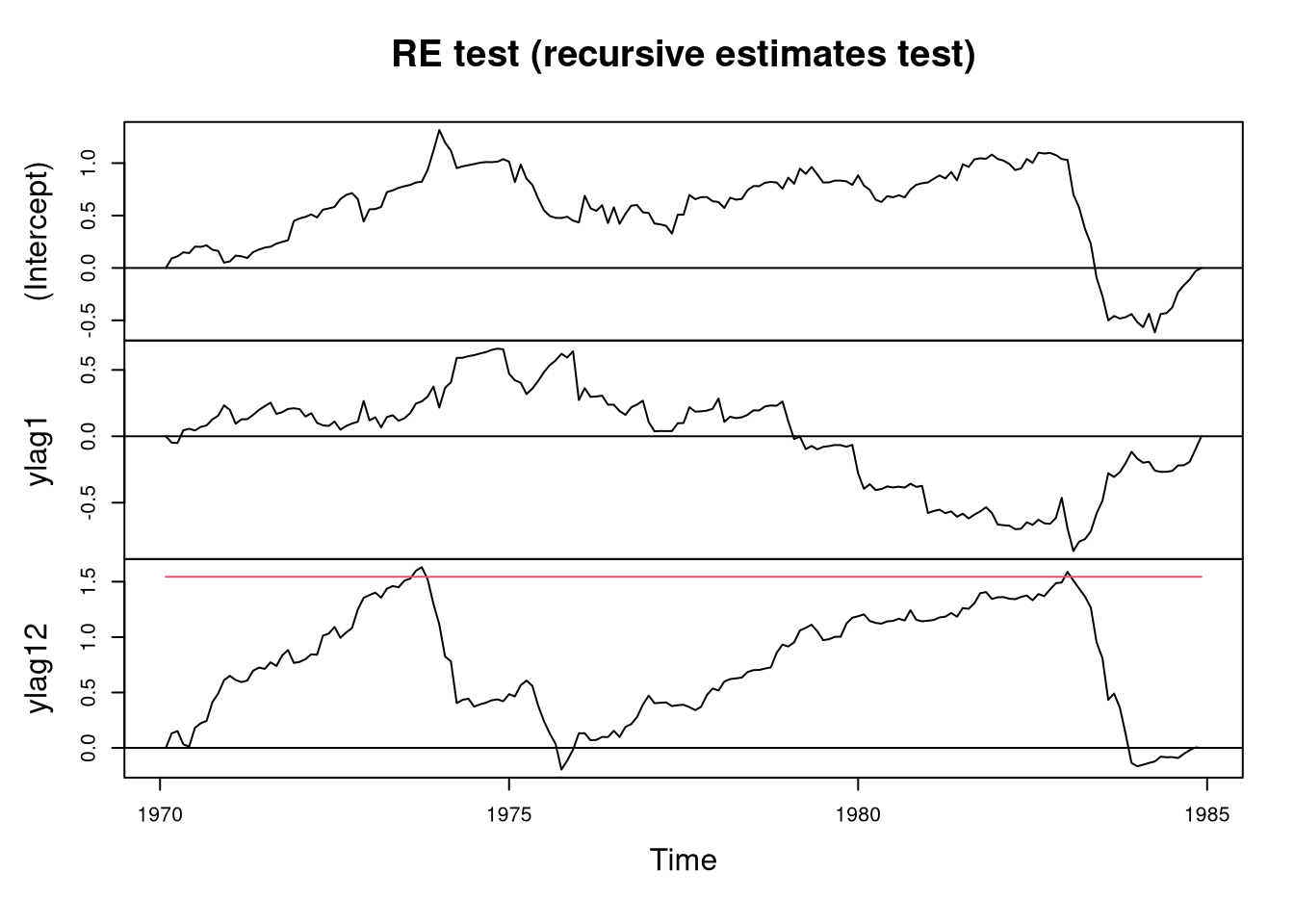
If type is either “RE” or “ME” a k-dimensional process will be returned, if k is the number of regressors in the model, as it is based on recursive OLS estimates of the regression coefficients or moving OLS estimates respectively. The recursive estimates test is also called fluctuation test, therefore setting type to “fluctuation” was used to specify it in earlier versions of strucchange. It still can be used now, but will be forced to “RE”.
If type is “Score-CUSUM” or “Score-MOSUM” a k+1-dimensional process will be returned, one for each score of the regression coefficients and one for the scores of the variance. The process gives the decorrelated cumulative sums of the ML scores (in a Gaussian model) or first order conditions respectively (in an OLS framework).
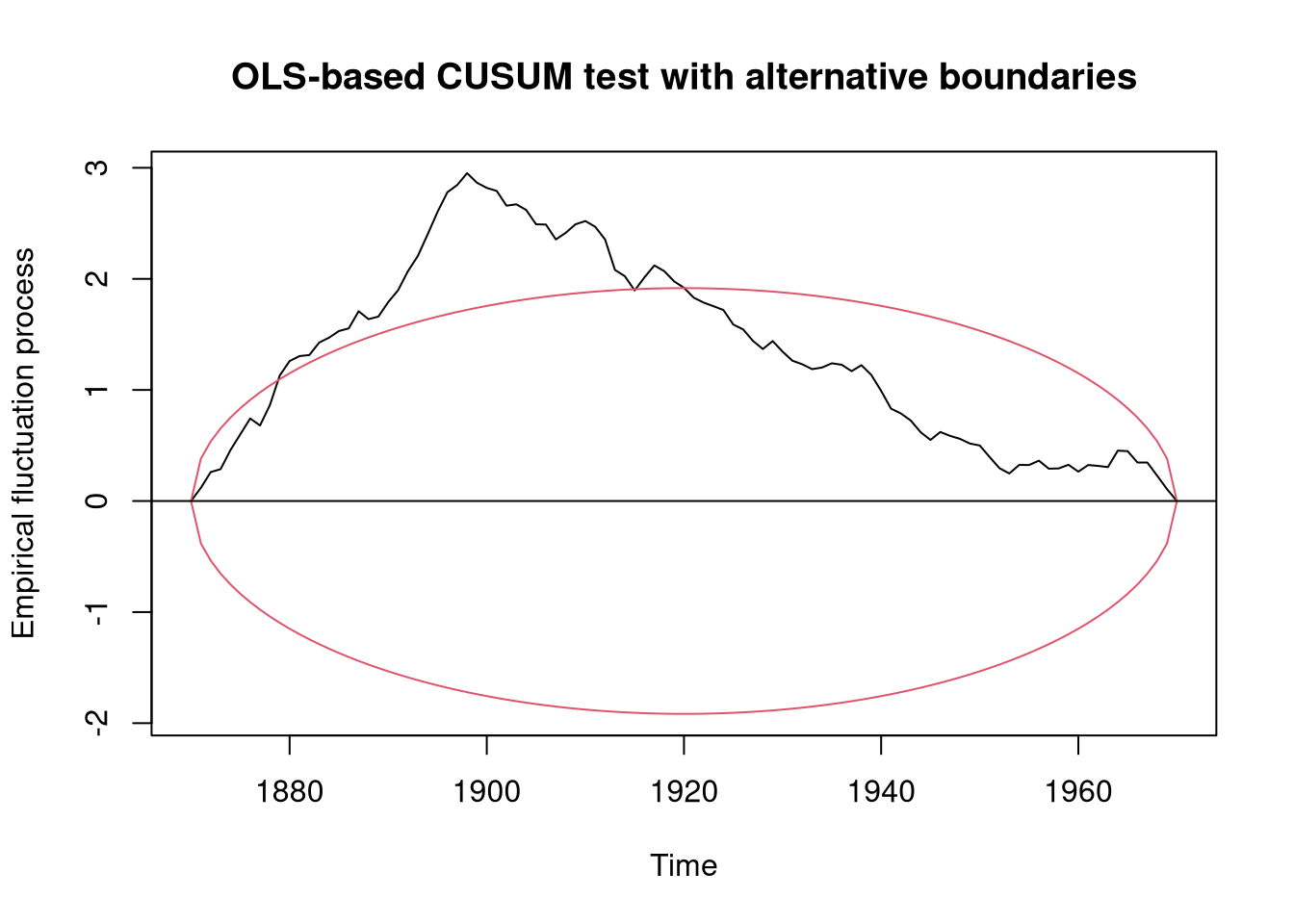
If there is a single structural change point \(t^*\), the recursive CUSUM path starts to depart from its mean 0 at \(t^*\). The Brownian bridge type paths will have their respective peaks around \(t^*\). The Brownian bridge increments type paths should have a strong change at \(t^*\).
The function plot has a method to plot the empirical fluctuation process; with sctest the corresponding test on structural change can be performed.
References
Brown R.L., Durbin J., Evans J.M. (1975), Techniques for testing constancy of regression relationships over time, Journal of the Royal Statistical Society, B, 37, 149-163.
Chu C.-S., Hornik K., Kuan C.-M. (1995), MOSUM tests for parameter constancy, Biometrika, 82, 603-617.
Chu C.-S., Hornik K., Kuan C.-M. (1995), The moving-estimates test for parameter stability, Econometric Theory, 11, 669-720.
Hansen B. (1992), Testing for Parameter Instability in Linear Models, Journal of Policy Modeling, 14, 517-533.
Hjort N.L., Koning A. (2002), Tests for Constancy of Model Parameters Over Time, Nonparametric Statistics, 14, 113-132.
Krämer W., Ploberger W., Alt R. (1988), Testing for structural change in dynamic models, Econometrica, 56, 1355-1369.
Kuan C.-M., Hornik K. (1995), The generalized fluctuation test: A unifying view, Econometric Reviews, 14, 135 - 161.
Kuan C.-M., Chen (1994), Implementing the fluctuation and moving estimates tests in dynamic econometric models, Economics Letters, 44, 235-239.
Ploberger W., Krämer W. (1992), The CUSUM test with OLS residuals, Econometrica, 60, 271-285.
Zeileis A., Leisch F., Hornik K., Kleiber C. (2002), strucchange: An R Package for Testing for Structural Change in Linear Regression Models, Journal of Statistical Software, 7(2), 1-38. doi:10.18637/jss.v007.i02.
Zeileis A. (2005), A Unified Approach to Structural Change Tests Based on ML Scores, F Statistics, and OLS Residuals. Econometric Reviews, 24, 445–466. doi:10.1080/07474930500406053.
Zeileis A. (2006), Implementing a Class of Structural Change Tests: An Econometric Computing Approach. Computational Statistics & Data Analysis, 50, 2987–3008. doi:10.1016/j.csda.2005.07.001.
Zeileis A., Hornik K. (2007), Generalized M-Fluctuation Tests for Parameter Instability, Statistica Neerlandica, 61, 488–508. doi:10.1111/j.1467-9574.2007.00371.x.