a symbolic description of the model to be fit. This should be of type y ~ x1 + x2 where y should be a matrix of response frequencies and x1 and x2 are used as partitioning variables.
data
an optional data frame containing the variables in the model.
na.action
a function which indicates what should happen when the data contain NAs, defaulting to na.pass.
cluster
optional vector (typically numeric or factor) with a cluster ID to be employed for clustered covariances in the parameter stability tests.
spec, treeid, optimargs
arguments for the MPT model passed on to mptmodel.
…
arguments passed to mob_control.
Details
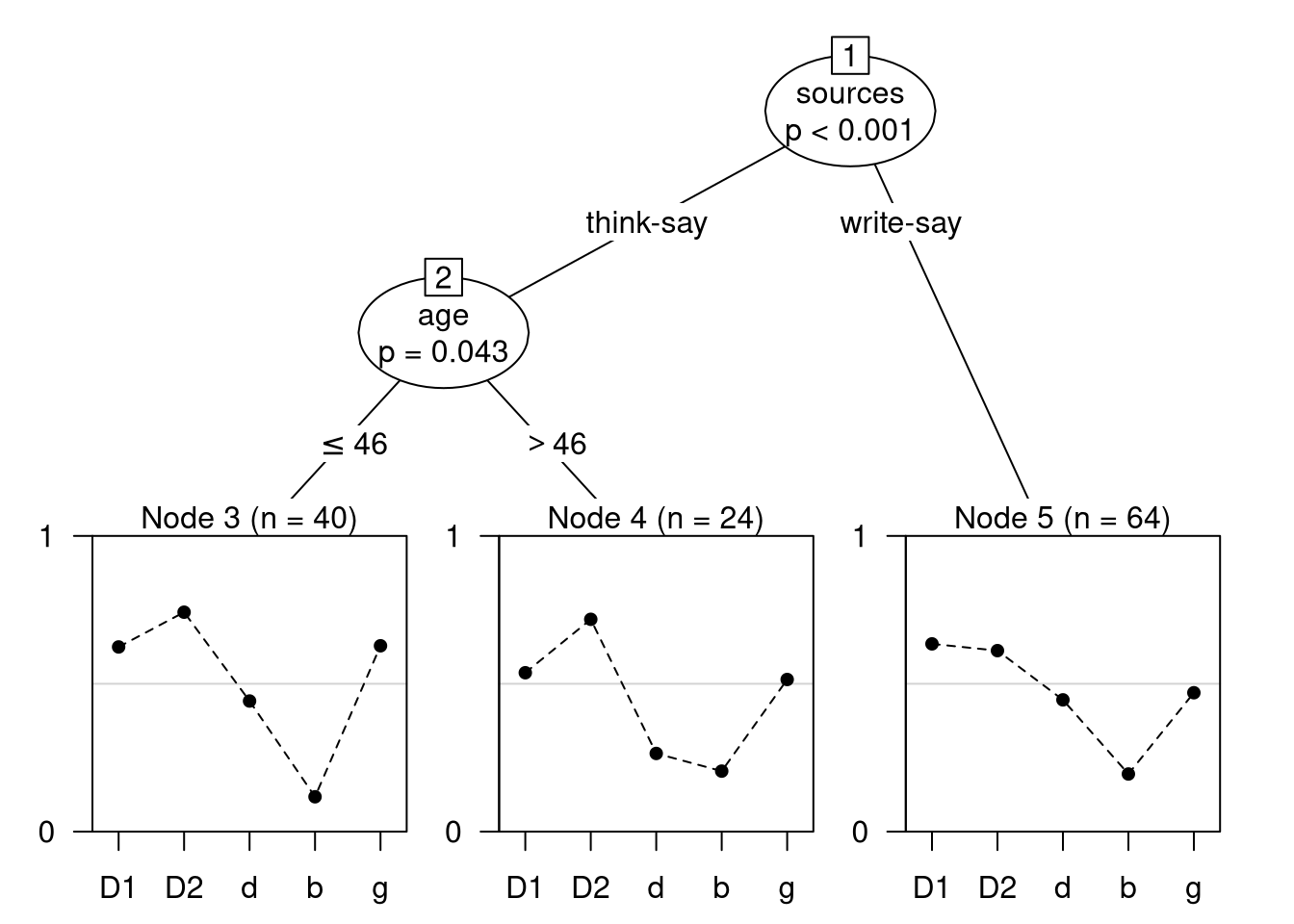
MPT trees (Wickelmaier & Zeileis, 2018) are an application of model-based recursive partitioning (implemented in mob) to MPT models (implemented in mptmodel). See Wickelmaier & Zeileis (2018) for a detailed discussion. For technical and algorithmic details, see the documentation of the two core functions linked above as well as vignette(“mob”, package = “partykit”).
Various methods are provided for “mpttree” objects, most of them inherit their behavior from “mob” objects (e.g., print, summary, etc.). The plot method employs the node_mptplot panel-generating function.
Value
An object of S3 class “mpttree” inheriting from class “modelparty”.
References
Wickelmaier F, Zeileis A (2018). Using Recursive Partitioning to Account for Parameter Heterogeneity in Multinomial Processing Tree Models. Behavior Research Methods, 50(3), 1217–1233. doi:10.3758/s13428-017-0937-z