library("glmx")

## Generate artifical binary data from a latent
## heteroscedastic normally distributed variable
set.seed(48)
n <- 200
x <- rnorm(n)
ystar <- 1 + x +  rnorm(n, sd = exp(x))
y  <- factor(ystar > 0)

## visualization
par(mfrow = c(1, 2))
plot(ystar ~ x, main = "latent")
abline(h = 0, lty = 2)
plot(y ~ x, main = "observed")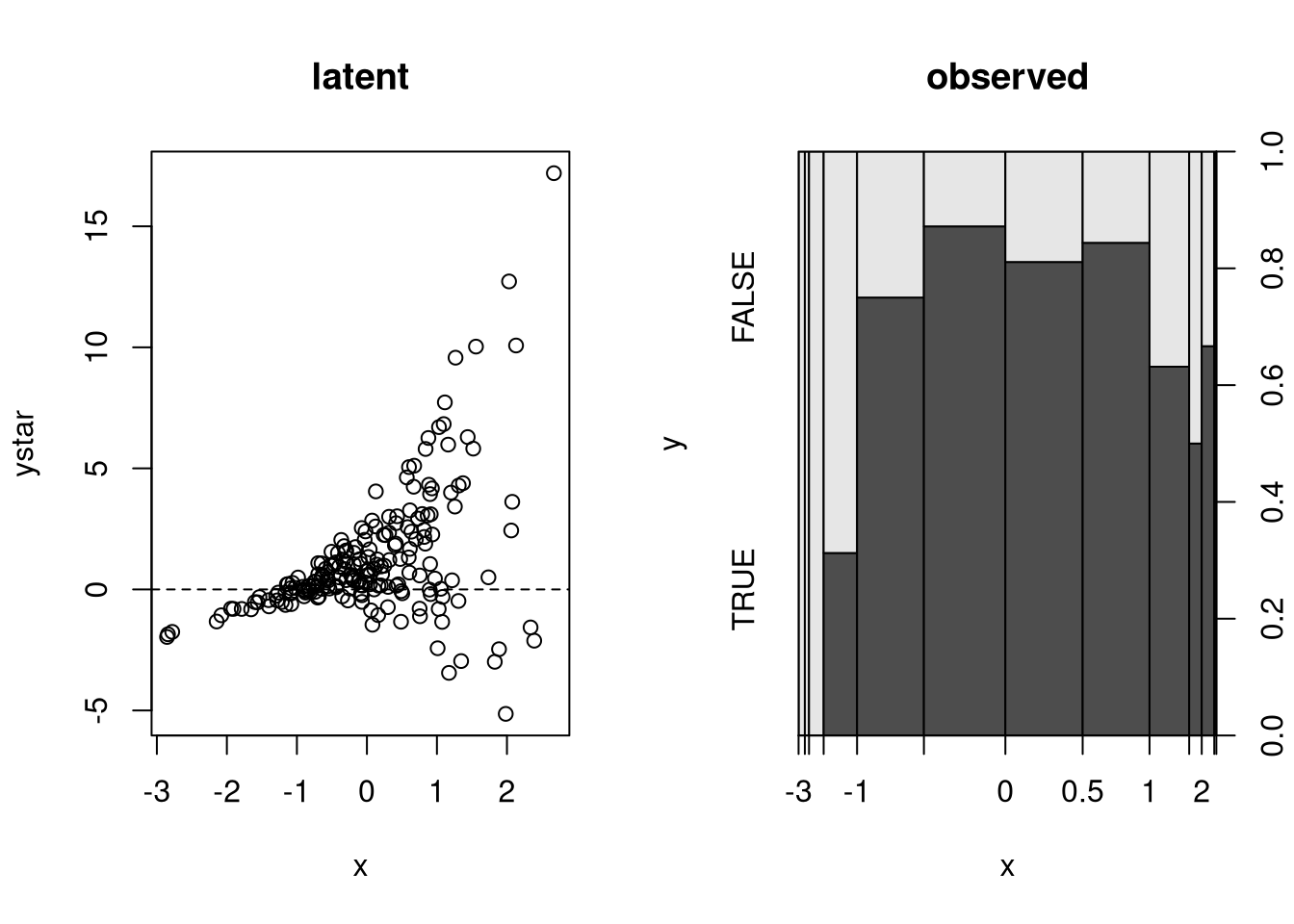
            heteroscedastic homoscedastic
(Intercept)        1.109258     0.5320893
x                  1.086656     0.3262606
(scale)_x          1.267372     0.0000000
## summary of correct heteroscedastic model
summary(m)
Call:
hetglm(formula = y ~ x)

Deviance residuals:
    Min      1Q  Median      3Q     Max
-2.0380 -0.0022  0.5467  0.6974  1.5845

Coefficients (binomial model with probit link):
            Estimate Std. Error z value Pr(>|z|)
(Intercept)   1.1093     0.1401   7.918 2.42e-15 ***
x             1.0867     0.1492   7.284 3.24e-13 ***

Latent scale model coefficients (with log link):
  Estimate Std. Error z value Pr(>|z|)
x   1.2674     0.2015   6.291 3.16e-10 ***
---
Signif. codes:  0 '***' 0.001 '**' 0.01 '*' 0.05 '.' 0.1 ' ' 1

Log-likelihood: -92.92 on 3 Df
LR test for homoscedasticity: 46.14 on 1 Df, p-value: 1.101e-11
Dispersion: 1
Number of iterations in nlminb optimization: 9
## Generate artificial binary data with a single binary regressor
## driving the heteroscedasticity in a model with two regressors
set.seed(48)
n <- 200
x <- rnorm(n)
z <- rnorm(n)
a <- factor(sample(1:2, n, replace = TRUE))
ystar <- 1 + c(0, 1)[a] + x + z + rnorm(n, sd = c(1, 2)[a])
y <- factor(ystar > 0)
## fit "true" heteroscedastic model
m1 <- hetglm(y ~ a + x + z | a)
## fit interaction model
m2 <- hetglm(y ~ a/(x + z) | 1)
## although not obvious at first sight, the two models are
## nested. m1 is a restricted version of m2 where the following
## holds: a1:x/a2:x == a1:z/a2:z
if(require("lmtest")) lrtest(m1, m2)Likelihood ratio test
Model 1: y ~ a + x + z | a
Model 2: y ~ a/(x + z) | 1
#Df LogLik Df Chisq Pr(>Chisq)
1 5 -75.088
2 6 -75.064 1 0.0466 0.8292 x.a1:x z.a1:z
3.758025 3.179625 if(require("AER")) {
## Labor force participation example from Greene
## (5th edition: Table 21.3, p. 682)
## (6th edition: Table 23.4, p. 790)
## data (including transformations)
data("PSID1976", package = "AER")
PSID1976$kids <- with(PSID1976, factor((youngkids + oldkids) > 0,
levels = c(FALSE, TRUE), labels = c("no", "yes")))
PSID1976$fincome <- PSID1976$fincome/10000
## Standard probit model via glm()
lfp0a <- glm(participation ~ age + I(age^2) + fincome + education + kids,
data = PSID1976, family = binomial(link = "probit"))
## Standard probit model via hetglm() with constant scale
lfp0b <- hetglm(participation ~ age + I(age^2) + fincome + education + kids | 1,
data = PSID1976)
## Probit model with varying scale
lfp1 <- hetglm(participation ~ age + I(age^2) + fincome + education + kids | kids + fincome,
data = PSID1976)
## Likelihood ratio and Wald test
lrtest(lfp0b, lfp1)
waldtest(lfp0b, lfp1)
## confusion matrices
table(true = PSID1976$participation,
predicted = fitted(lfp0b) <= 0.5)
table(true = PSID1976$participation,
predicted = fitted(lfp1) <= 0.5)
## Adapted (and somewhat artificial) example to illustrate that
## certain models with heteroscedastic scale can equivalently
## be interpreted as homoscedastic scale models with interaction
## effects.
## probit model with main effects and heteroscedastic scale in two groups
m <- hetglm(participation ~ kids + fincome | kids, data = PSID1976)
## probit model with interaction effects and homoscedastic scale
p <- glm(participation ~ kids * fincome, data = PSID1976,
family = binomial(link = "probit"))
## both likelihoods are equivalent
logLik(m)
logLik(p)
## intercept/slope for the kids=="no" group
coef(m)[c(1, 3)]
coef(p)[c(1, 3)]
## intercept/slope for the kids=="yes" group
c(sum(coef(m)[1:2]), coef(m)[3]) / exp(coef(m)[4])
coef(p)[c(1, 3)] + coef(p)[c(2, 4)]
## Wald tests for the heteroscedasticity effect in m and the
## interaction effect in p are very similar
coeftest(m)[4,]
coeftest(p)[4,]
## corresponding likelihood ratio tests are equivalent
## (due to the invariance of the MLE)
m0 <- hetglm(participation ~ kids + fincome | 1, data = PSID1976)
p0 <- glm(participation ~ kids + fincome, data = PSID1976,
family = binomial(link = "probit"))
lrtest(m0, m)
lrtest(p0, p)
}Likelihood ratio test
Model 1: participation ~ kids + fincome
Model 2: participation ~ kids * fincome
#Df LogLik Df Chisq Pr(>Chisq)
1 3 -510.65
2 4 -510.10 1 1.0947 0.2954