Mexican Women’s Labor-Force Participation

Description

Data from the National Survey of Household Income and Expenditures for 1977, Secretaria de Programacion y Presupuesto, Mexico.

Usage

data("MexicanLabor")

Format

A data frame containing 16 observations on 6 variables.

total
integer. Number of women older than 12 years.
laborforce
integer. Number of women in labor force.
locality
factor with levels “rural”/“urban”.
age
factor with levels “<= 24” and “> 24” (in years).
income
factor with levels “low”/“high” (household income less or more than $2626.8).
schooling
factor with levels “primary” (primary school or less) and “further” (more than primary school).

Details

The data were first analyzed by Guerrero and Johnson (1982) as an example of a highly asymmetric data set, i.e., the observed proportions are rather low.

Source

Guerrero V, Johnson R (1982). “Use of the Box-Cox Transformation with Binary Response Models.” Biometrika, 69, 309–314.

Examples

library("glmx")

## data
data("MexicanLabor", package = "glmx")

## visualizations
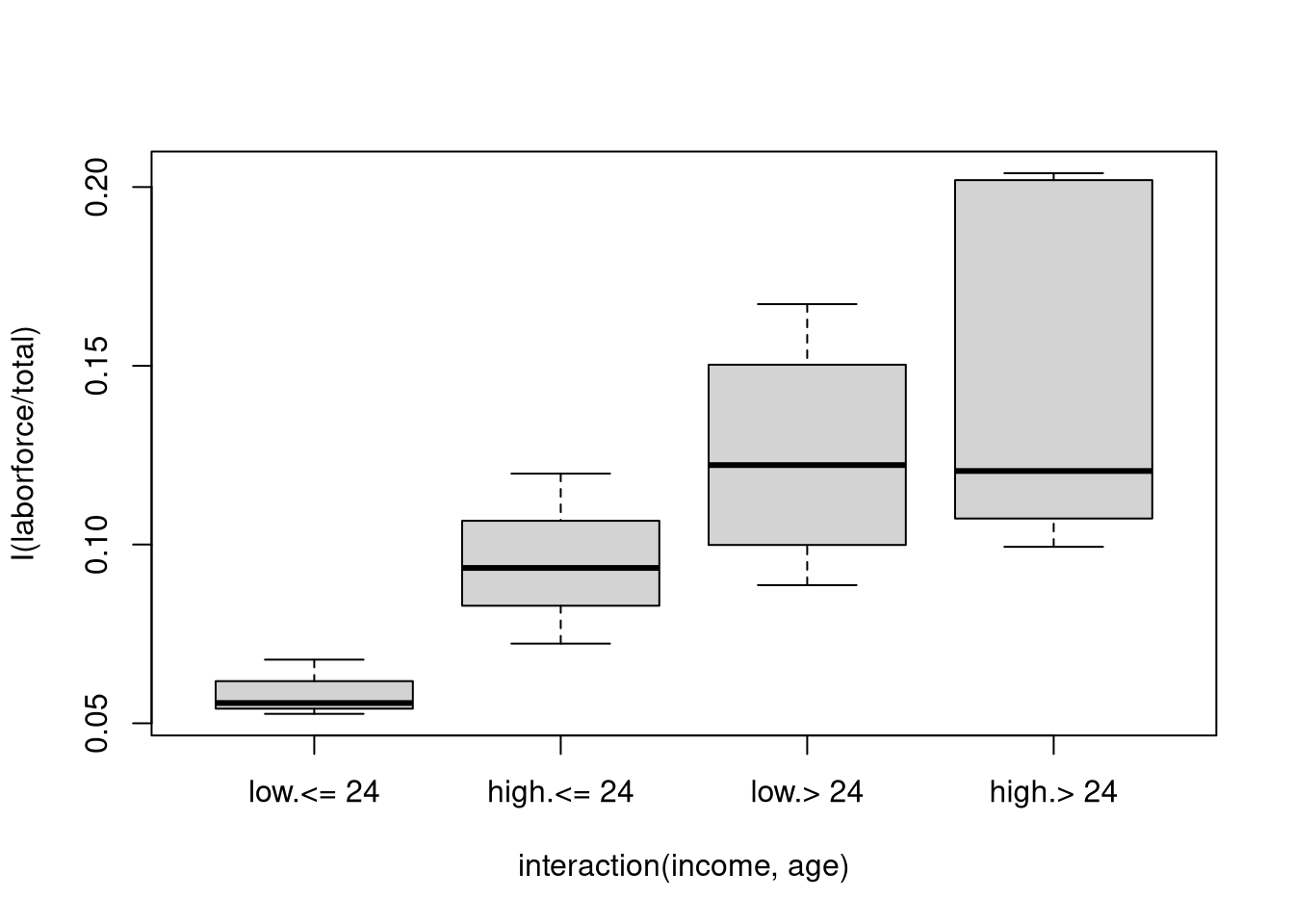
plot(I(laborforce/total) ~ interaction(income, age), data = MexicanLabor)

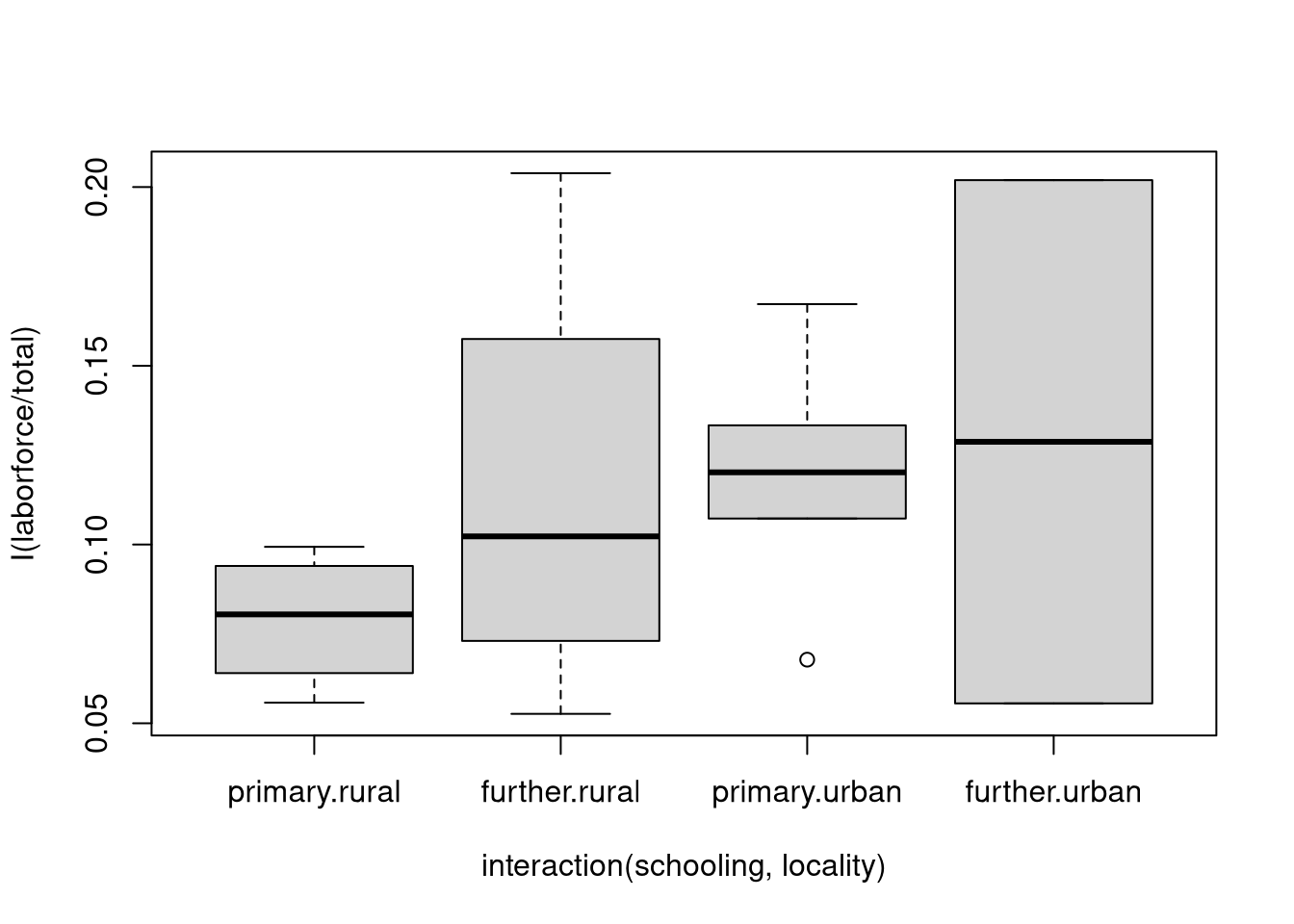
plot(I(laborforce/total) ~ interaction(schooling, locality), data = MexicanLabor)
## simple logit model
m <- glm(cbind(laborforce, total - laborforce) ~ ., data = MexicanLabor, family = binomial)
m

Call:  glm(formula = cbind(laborforce, total - laborforce) ~ ., family = binomial, 
    data = MexicanLabor)

Coefficients:
     (Intercept)     localityurban           age> 24        incomehigh  
        -2.58575           0.38931           0.29212          -0.01521  
schoolingfurther  
         0.54814  

Degrees of Freedom: 15 Total (i.e. Null);  11 Residual
Null Deviance:      73.89 
Residual Deviance: 15.96    AIC: 95.61