Productivity and Quit Behavior of Western Electric Workers

Description

Partially artificial data about quit behavior of Western Electric workers. (Western Electric was the manufacturing arm of the AT&T corporation during its glory days as a monopolist in the U.S. telephone industry.)

Usage

data("WECO")

Format

A data frame containing 683 observations on 7 variables.

output
productivity in first six months.
sex
factor indicating gender.
dex
score on a preemployment dexterity exam.
lex
years of education.
kwit
factor indicating whether the worker quit in the first six months.
tenure
duration of employment (see details).
censored
logical. Is the duration censored?

Details

The explanatory variables in this example are taken from the study of Klein et al. (1991), but the response variable was altered long ago to improve the didactic impact of the model as a class exercise. To this end, quit dates for each individual were generated according to a log Weibull proportional hazard model.

Source

Online supplements to Koenker (2006) and Koenker and Yoon (2009).

http://www.econ.uiuc.edu/~roger/research/links/links.html

References

Klein R, Spady R, Weiss A (1991). “Factors Affecting the Output and Quit Propensities of Production Workers.” The Review of Economic Studies, 58(5), 929–953.

Koenker R (2006). “Parametric Links for Binary Response.” R News, 6(4), 32–34.

Koenker R, Yoon J (2009). “Parametric Links for Binary Choice Models: A Fisherian-Bayesian Colloquy.” Journal of Econometrics, 152, 120–130.

See Also

plinks

Examples

library("glmx")


## WECO data
data("WECO", package = "glmx")
f <- kwit ~ sex + dex + poly(lex, 2, raw = TRUE)
## (raw = FALSE would be numerically more stable)

## Gosset model
gossbin <- function(nu) binomial(link = gosset(nu))
m1 <- glmx(f, data = WECO,
  family = gossbin, xstart = 0, xlink = "log")

## Pregibon model
pregibin <- function(shape) binomial(link = pregibon(shape[1], shape[2]))
m2 <- glmx(f, data = WECO,
  family = pregibin, xstart = c(0, 0), xlink = "identity")

## Probit/logit/cauchit models
m3 <- lapply(c("probit", "logit", "cauchit"), function(nam)
  glm(f, data = WECO, family = binomial(link = nam)))

## Probit/cauchit vs. Gosset
if(require("lmtest")) {
lrtest(m3[[1]], m1)
lrtest(m3[[3]], m1)

## Logit vs. Pregibon
lrtest(m3[[2]], m2)
}
Likelihood ratio test

Model 1: kwit ~ sex + dex + poly(lex, 2, raw = TRUE)
Model 2: f
  #Df  LogLik Df  Chisq Pr(>Chisq)    
1   5 -368.33                         
2   7 -360.91  2 14.845  0.0005976 ***
---
Signif. codes:  0 '***' 0.001 '**' 0.01 '*' 0.05 '.' 0.1 ' ' 1
## Table 1
tab1 <- sapply(c(m3, list(m1)), function(obj)
  c(head(coef(obj), 5), AIC(obj)))
colnames(tab1) <- c("Probit", "Logit", "Cauchit", "Gosset")
rownames(tab1)[4:6] <- c("lex", "lex^2", "AIC")
tab1 <- round(t(tab1), digits = 3)
tab1
        (Intercept) sexmale    dex    lex lex^2     AIC
Probit        3.549   0.268 -0.053 -0.313 0.012 748.711
Logit         6.220   0.479 -0.094 -0.539 0.021 746.663
Cauchit       8.234   0.677 -0.125 -0.694 0.028 736.881
Gosset       20.364   1.675 -0.297 -1.730 0.069 734.409
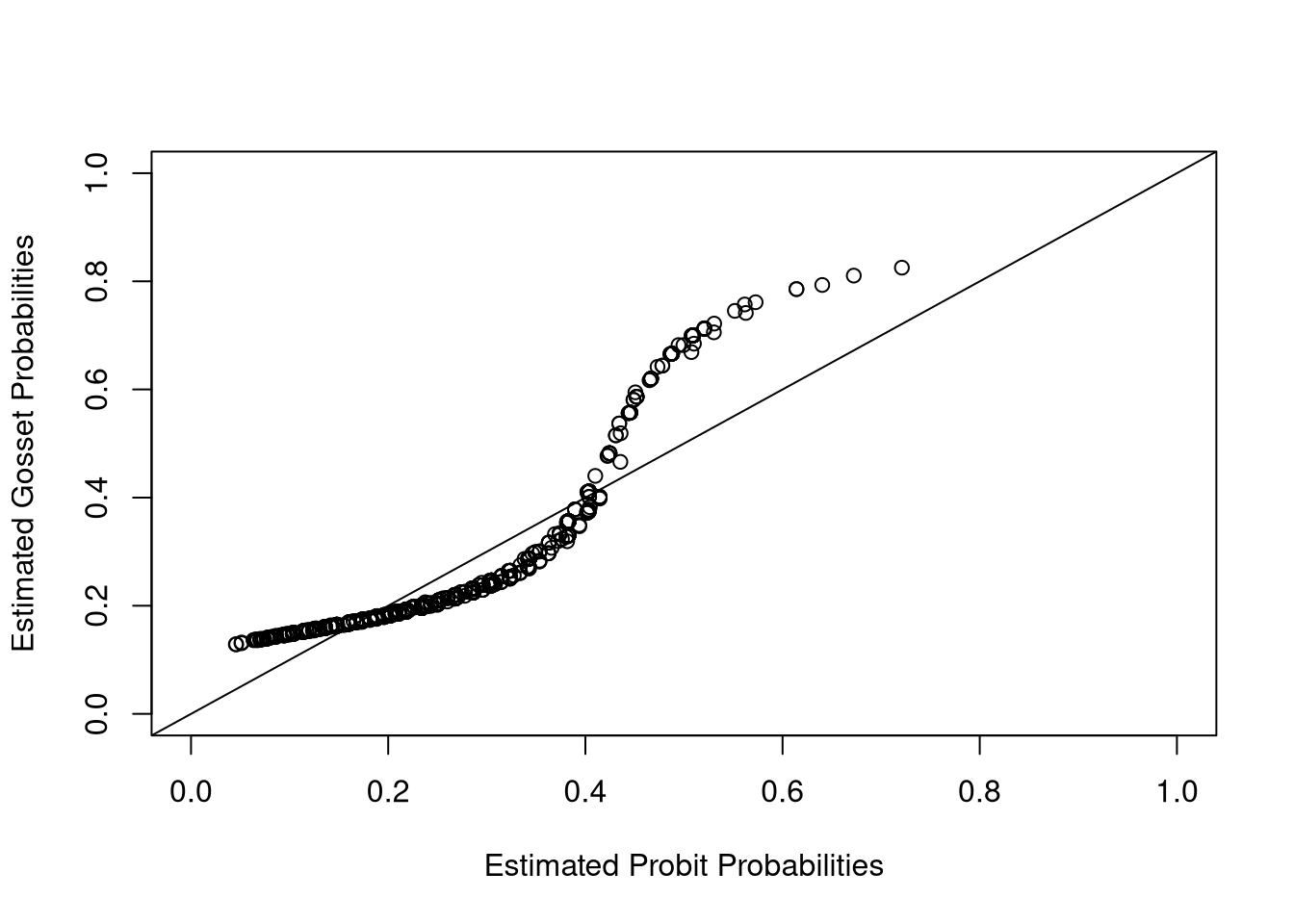
## Figure 4
plot(fitted(m3[[1]]), fitted(m1),
  xlim = c(0, 1), ylim = c(0, 1),
  xlab = "Estimated Probit Probabilities",
  ylab = "Estimated Gosset Probabilities")
abline(0, 1)