Usage
fxmonitor(formula, data, start, end = 3, alpha = 0.05, meat. = NULL)

## S3 method for class 'fxmonitor'
plot(x, which = NULL, aggregate = NULL,
  ylim = NULL, xlab = "Time", ylab = "Empirical fluctuation process",
  main = "Monitoring of FX model", ...)
Details
fxmonitor is a function for monitoring exchange rate regression models (also known as Frankel-Wei models). It fits the model on the history period (before start) and computes the predicted scores (or estimating functions) on the monitoring period. The scaled and decorrelated process can be employed for monitoring as described by Zeileis (2005) using a double-maximum-type procedure with linear boundary. The critical values are interpolated from Table III in Zeileis et al. (2005).
Because the model just has to be fitted once (and not updated with every incoming observation), the interface of fxmonitor is much simpler than that of mefp: The data should just include all available observations (including history and monitoring period). Instead of updating the model with each incoming observation, the whole procedure has to be repeated.
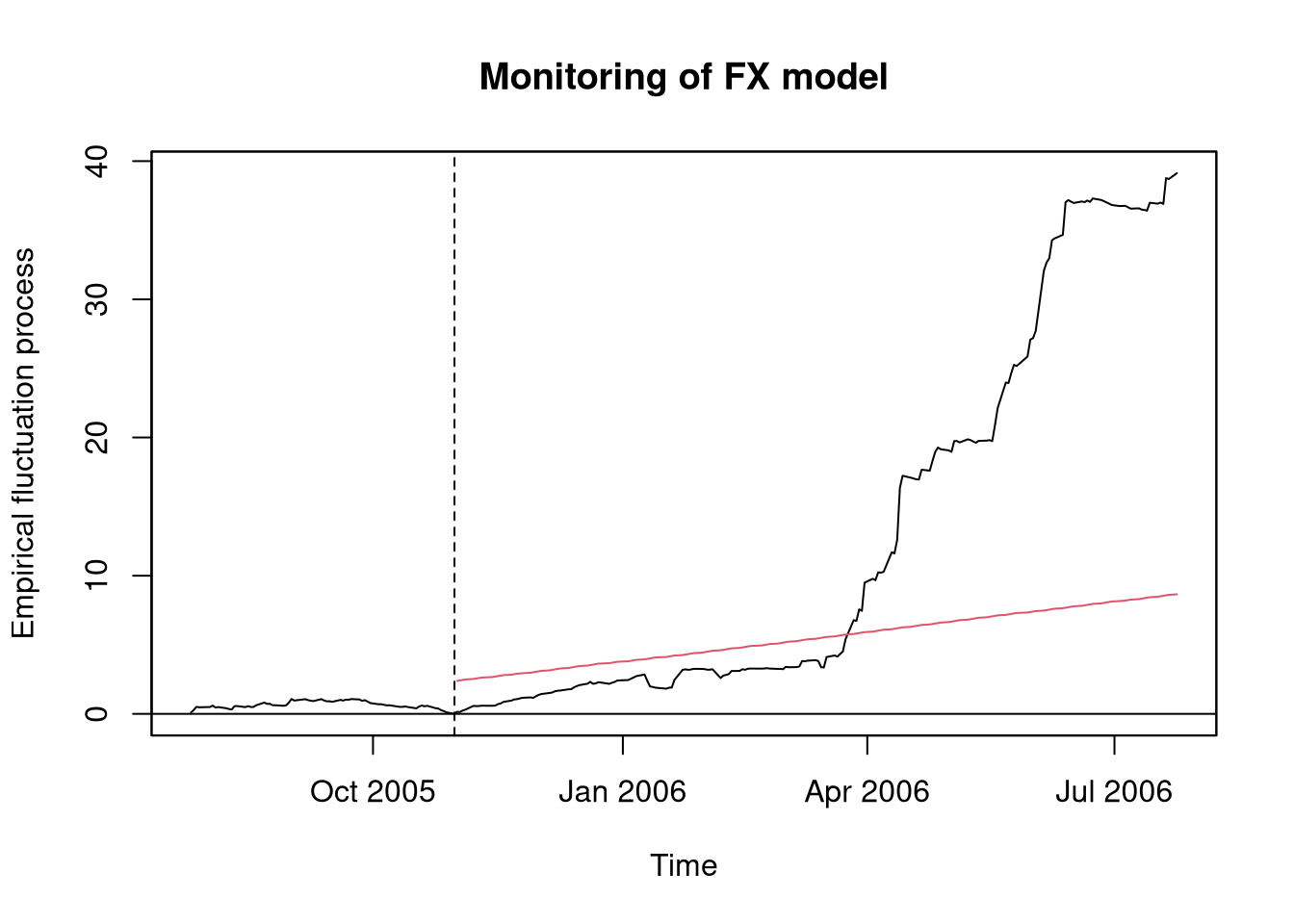
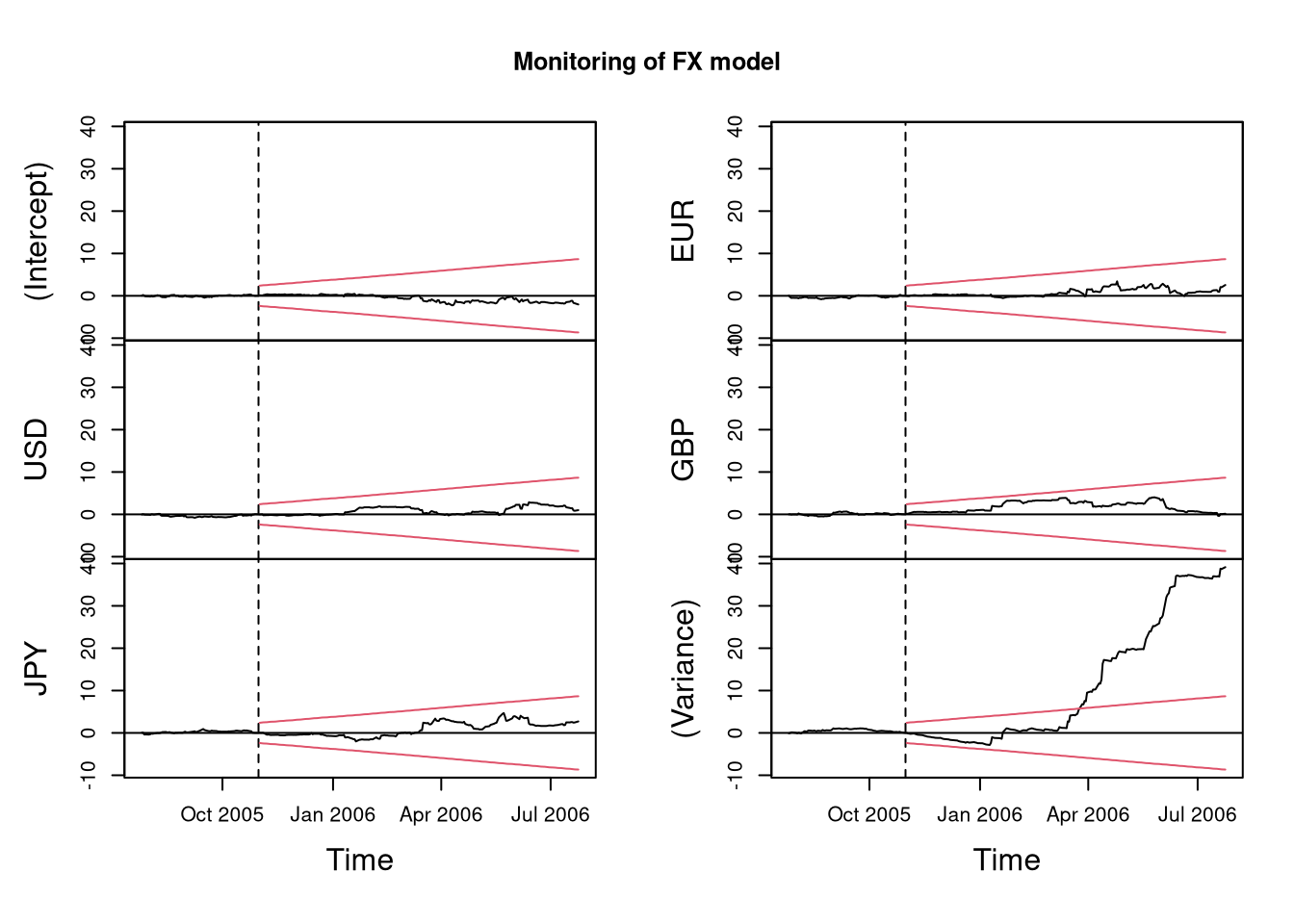
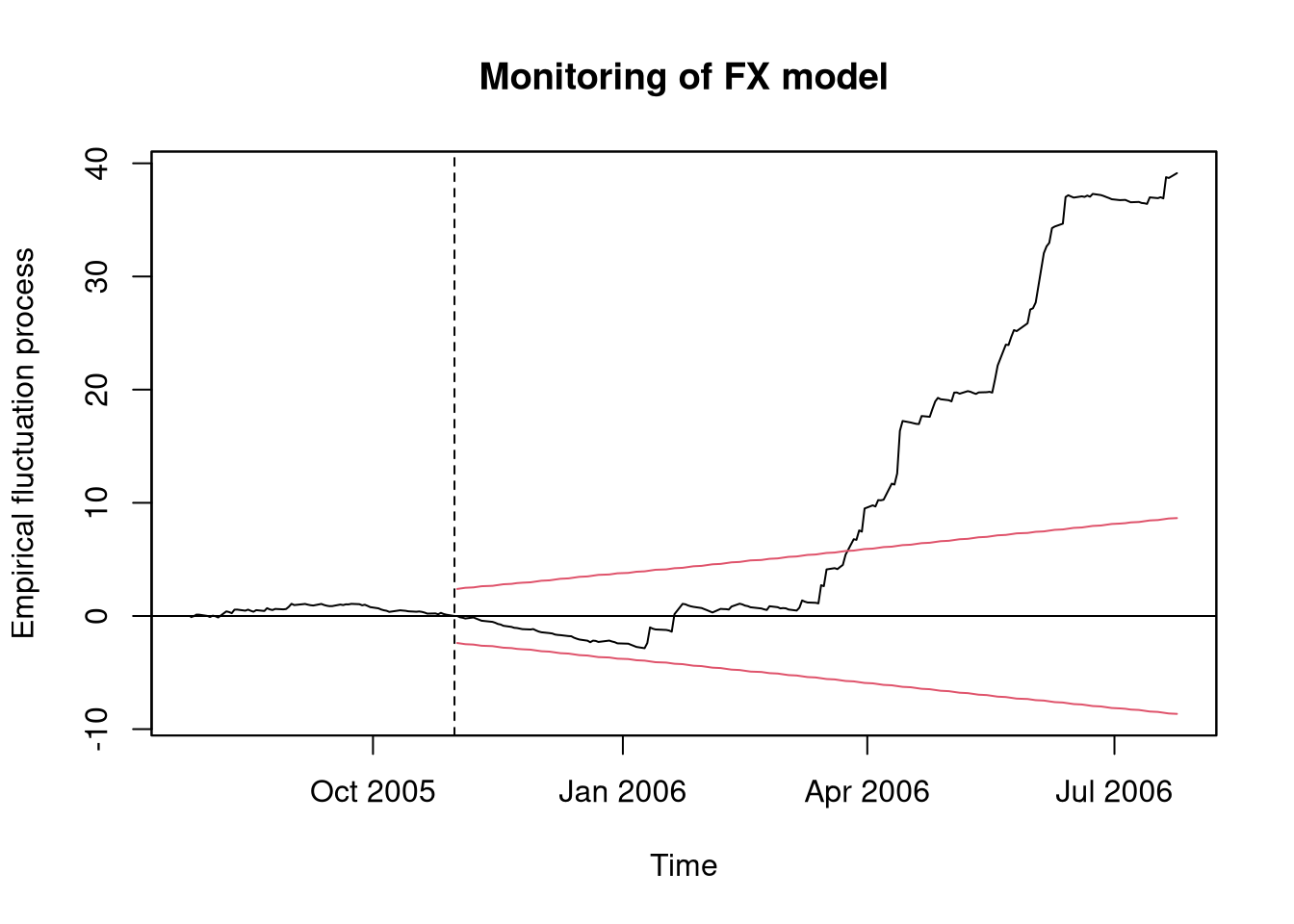
The plot method visualizes the monitoring process along with its boundaries. The print method reports the breakdate (time of the first boundary crossing, if any), which can also be queried by the breakpoints and breakdates methods.
References
Zeileis A., Leisch F., Kleiber C., Hornik K. (2005), Monitoring Structural Change in Dynamic Econometric Models, Journal of Applied Econometrics, 20, 99–121.
Zeileis A. (2005), A Unified Approach to Structural Change Tests Based on ML Scores, F Statistics, and OLS Residuals. Econometric Reviews, 24, 445–466.
Shah A., Zeileis A., Patnaik I. (2005), What is the New Chinese Currency Regime?, Report 23, Department of Statistics and Mathematics, Wirtschaftsuniversitaet Wien, Research Report Series, November 2005. http://epub.wu.ac.at.
Zeileis A., Shah A., Patnaik I. (2010), Testing, Monitoring, and Dating Structural Changes in Exchange Rate Regimes, Computational Statistics and Data Analysis, 54(6), 1696–1706. doi:10.1016/j.csda.2009.12.005.