library("crch")

# generate data
suppressWarnings(RNGversion("3.5.0"))
set.seed(5)
x <- matrix(rnorm(1000*20),1000,20)
y <- rnorm(1000, 1 + x[,1] - 1.5 * x[,2], exp(-1 + 0.3*x[,3]))
y <- pmax(0, y)
data <- data.frame(cbind(y, x))

# fit model with maximum likelihood
CRCH <- crch(y ~ .|., data = data, dist = "gaussian", left = 0)

# fit model with boosting
boost <- crch(y ~ .|.,  data = data, dist = "gaussian", left = 0,
  control = crch.boost(mstop = "aic"))

# more conveniently, the same model can also be fit through
# boost <- crch(y ~ .|.,  data = data, dist = "gaussian", left = 0,
#   method = "boosting", mstop = "aic")

# AIC comparison
AIC(CRCH, boost)
df AIC
CRCH 42 819.2673
boost 7 782.1219# summary
summary(boost)
Call:
crch(formula = y ~ . | ., data = data, dist = "gaussian", left = 0, control = crch.boost(mstop = "aic"))

Standardized residuals:
    Min      1Q  Median      3Q     Max
-2.9273 -0.2963  0.5462  1.4357 22.6650

maximum stopping iteration: 100

optimum stopping iterations:
max aic bic
100  90  90

Non-zero coefficients after 90 boosting iterations:
Location model:
(Intercept)           V2           V3          V13          V21
    0.99111      1.01795     -1.49731      0.04483      0.03668

Scale model with log link:
(Intercept)           V4
    -0.9183       0.2226

Distribution: gaussian
Log-likelihood: -384.1 on 7 Df
# plot
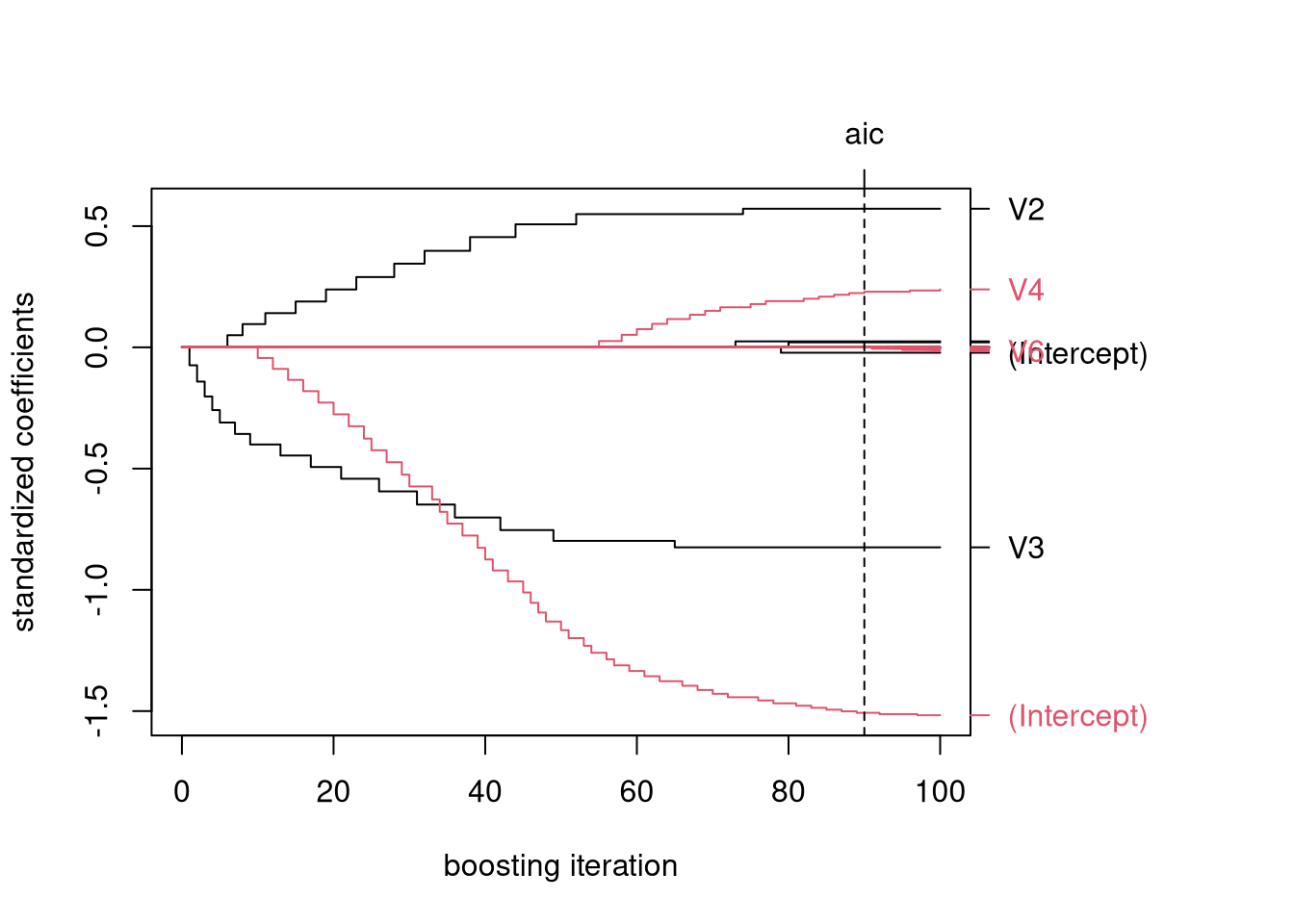
plot(boost)